

Understanding the Cost of a Forex License in the UAE: A Comprehensive 2026 Guide
A UAE forex license is an investment in institutional credibility where the cost is a barrier to entry that secures long-term market trust. You likely recognize that the true cost of forex license uae involves much more than a single registration fee paid to a regulator. It’s common to feel overwhelmed by the opaque fee structures and the high capital requirements that vary significantly between the DIFC, DMCC, and mainland SCA jurisdictions. We understand that clarity is your most valuable asset when budgeting for a multi-million dirham venture.
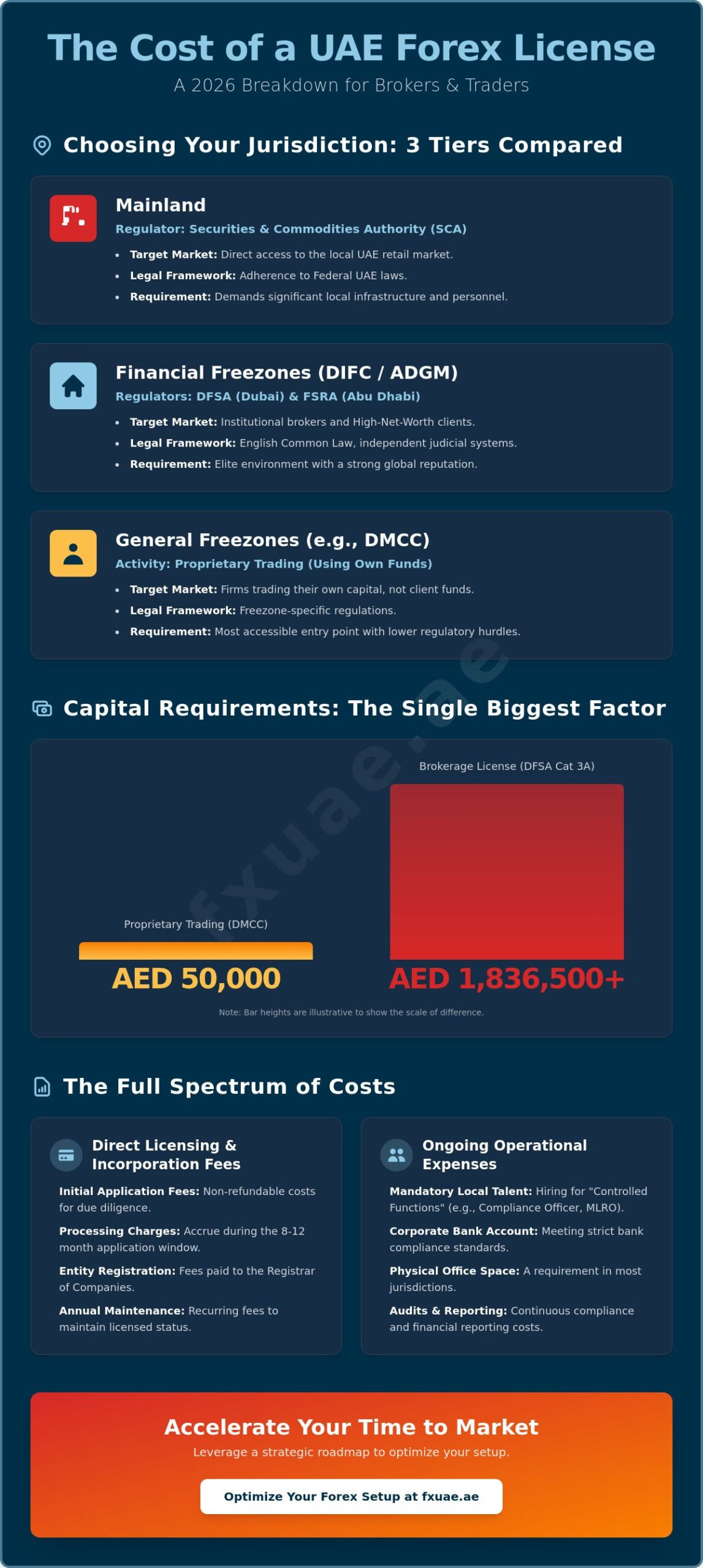
This guide provides a comprehensive breakdown of the regulatory fees, mandatory share capital, and the operational costs necessary to secure your license in 2026. You’ll learn how to distinguish between the AED 50,000 capital requirement for proprietary trading in the DMCC and the more substantial AED 1,836,500 base capital needed for a DFSA Category 3A license. We also outline a strategic roadmap for navigating the complexities of corporate bank account opening and meeting strict local compliance standards. By the end of this article, you’ll have a clear budget framework to identify the most cost-effective path for your specific business model.
Key Takeaways
- Identify the optimal regulatory environment for your business model by comparing the Securities and Commodities Authority (SCA) requirements with specialized financial free zones.
- Calculate the total cost of forex license uae by accounting for initial application fees, incorporation charges, and recurring annual regulatory maintenance.
- Prepare for capital adequacy requirements that range from AED 50,000 for proprietary trading to over AED 1,836,500 for high-tier brokerage categories.
- Evaluate the operational impact of hiring mandatory local talent for “Controlled Functions,” such as Compliance Officers and MLROs, to satisfy strict governance standards.
- Accelerate your time to market by leveraging a roadmap that integrates specialized talent matching with successful forex bank account opening.
The UAE Forex Regulatory Landscape: Choosing Your Jurisdiction
Selecting the right jurisdiction is the most critical decision in your setup process. It dictates your regulatory burden, your target audience, and the total cost of forex license uae. The UAE offers three distinct tiers: Mainland, Financial Freezones, and General Freezones. Each path carries unique administrative fees and capital requirements. Your choice will depend on whether you intend to handle client funds, trade your own capital, or target institutional investors. This decision is the single biggest factor in your initial financial outlay.
The Securities and Commodities Authority (SCA) Framework
The Securities and Commodities Authority (SCA) serves as the primary national regulator for mainland financial activities. While the Central Bank of the UAE (CBUAE) oversees the broader banking and monetary system, the SCA specifically governs the licensing of securities and commodities brokers. A Mainland setup is often the preferred route for firms aiming to target the local retail market directly. It requires a physical presence in a mainland area and adheres to federal laws. While it offers broad market access, the compliance requirements are rigorous and demand significant investment in local infrastructure and specialized personnel.
Financial Freezones: DFSA vs. FSRA
The Dubai International Financial Centre (DIFC) and Abu Dhabi Global Market (ADGM) operate as specialized financial hubs. These zones provide an elite environment for institutional brokers and high-net-worth service providers. The Dubai Financial Services Authority (DFSA) and the Financial Services Regulatory Authority (FSRA) act as independent regulators within these zones. Institutional brokers favor these hubs for their global reputation and robust legal frameworks. These authorities maintain their own civil and commercial laws based on English Common Law, providing a familiar legal environment for international firms. The DFSA and FSRA operate as autonomous regulatory bodies, maintaining independent legal frameworks and judicial systems that exist separately from the federal UAE courts.
For those starting with a narrower focus, General Freezones like the DMCC offer a more accessible entry point. These are primarily used for proprietary trading where you trade with your own funds rather than managing client money. This path significantly lowers the cost of forex license uae because the regulatory risks are lower. We often see firms start here to establish a track record before transitioning to a full brokerage license in the DIFC or ADGM. Understanding these tiers ensures you don’t overspend on a license that provides more authority than your current business model requires.
Direct Licensing Fees and Incorporation Costs
Calculating the total cost of forex license uae requires a granular look at both upfront and recurring expenditures. You aren’t just paying for a piece of paper; you’re investing in a regulated status that demands continuous financial commitment. These costs are broadly divided into two streams: the fees paid directly to the regulator and the administrative expenses required to establish your legal entity. Understanding the legal framework for forex trading is essential here, as your chosen jurisdiction determines whether you face federal or free zone fee structures.
Initial Application and Processing Fees
Regulators like the DFSA or FSRA charge non-refundable application fees to cover the extensive due diligence they perform on your firm’s principals. These fees vary significantly based on your license category. For instance, a Category 4 license for advisory services carries a lower price tag than a Category 1 or 2 license, which allows for market-making and dealing in investments. It’s a common mistake to overlook the “processing charges” that accumulate during the 8 to 12-month application window. You should also differentiate between these sunk costs and the refundable share capital deposits you’ll make later in the process. Most authorities require these payments at specific milestones: a portion at the time of submission and the remainder upon “in-principle” approval.
Entity Registration and Administrative Overheads
Once the regulator signals approval, you must finalize your corporate structure with the Registrar of Companies. This involves drafting the Memorandum of Association (MOA), notarizing documents, and securing a physical office space. In the UAE, a virtual office or “flexi-desk” is rarely sufficient for a regulated forex firm. Regulators expect a substance-based presence where key management functions actually occur. This means your budget must include commercial lease deposits and fit-out costs. Additionally, you’ll face fees for establishment cards and residency visas for your board members and senior executive officers.
To avoid administrative delays that inflate your cost of forex license uae, ensure you have these five essential documents ready for notarization:
- A detailed three-year regulatory business plan.
- Comprehensive Anti-Money Laundering (AML) and Compliance manuals.
- A certified Board Resolution authorizing the setup.
- Attested Articles of Association tailored to financial activities.
- Proof of professional indemnity insurance or capital commitment.
Navigating these filings without expert guidance often leads to rejected applications and lost fees. If you’re looking for a streamlined path to market, exploring a tailored Freezone Company Setup can help you avoid the common pitfalls of DIY registration. Professional consultancy ensures your documentation meets regulatory expectations the first time, protecting your initial investment.
Capital Requirements and Financial Adequacy
Many founders mistakenly view capital as a simple administrative hurdle. In reality, the cost of forex license uae includes a permanent commitment of funds that must remain liquid within the business. This “Paid-up Capital” serves as a safety net for both the regulator and your future clients. You must prove the legitimacy of these funds through bank comfort letters and audited statements before any license is granted. This capital is not a fee, but it represents a significant liquidity requirement that impacts your overall setup budget.
Paid-up Capital by License Category
The specific amount required depends entirely on the scope of your activities. For a proprietary trading license in the DMCC, where you trade only your own funds, the standard share capital is AED 50,000. However, if you intend to manage client assets, the barrier to entry rises significantly. A Category 3A brokerage license in the DIFC requires a base capital of approximately AED 1,836,500. The Securities and Commodities Authority (SCA) generally mandates at least AED 500,000 for mainland brokerage activities. Regulators conduct thorough “fitness and propriety” checks to ensure the source of this capital is transparent and legal. It’s vital to remember that this capital must be maintained at all times, not just deposited during the initial application.
Professional Indemnity Insurance and Guarantees
Beyond the base capital, you must account for Professional Indemnity (PI) Insurance. This is a mandatory operational cost for all financial entities in the UAE. It protects the firm against potential negligence claims, legal costs, or professional errors. Some regulators also demand bank guarantees to provide an additional layer of protection for retail participants. Maintaining these standards requires consistent oversight and regular reporting. You’ll need to factor in the cost of quarterly audits to verify your capital adequacy ratios to the regulator. This ensures your firm stays compliant with the 2026 financial standards.
There is a sharp distinction between your operational capital and client-segregated funds. Your capital covers the firm’s risks, while client money must be held in dedicated, protected accounts. Successfully navigating this requires a robust strategy for Client Money Account Opening to ensure you meet the strict regulatory standards for fund segregation. Failure to maintain these separate pools of liquidity can lead to immediate license suspension and heavy fines. We help you establish the correct banking structure from day one to avoid these risks and manage the total cost of forex license uae effectively.
Operational Expenses: Compliance, Talent, and Banking
Securing your regulatory approval is only the first stage of your investment. The ongoing cost of forex license uae is heavily influenced by the operational infrastructure required to maintain that license. Regulators in the UAE, particularly the DFSA and FSRA, operate on a “substance over form” basis. This means you cannot simply hold a license on paper; you must demonstrate active, compliant operations within the country. These recurring expenses often represent a larger portion of the long-term budget than the initial registration fees.
Mandatory Personnel and Compliance Talent
Before a license is granted, you must appoint individuals to “Controlled Functions.” These roles are non-negotiable and include a Senior Executive Officer (SEO), a Compliance Officer, and a Money Laundering Reporting Officer (MLRO). Regulators typically require these key personnel to be resident in the UAE to ensure they are available for oversight and audits. This residency requirement creates a highly competitive market for licensed professionals, driving up salary expectations and recruitment costs. You’ll need to decide between hiring full-time internal staff or utilizing specialized support for certain functions. While internal teams provide dedicated focus, the high cost of local expertise makes Forex Compliance Assistance a strategic alternative for firms looking to optimize their operational spend without compromising on regulatory standards.
The Challenge of Client Money Accounts (CMA)
Opening a corporate bank account is often cited by founders as the most difficult part of the setup process. For forex brokers, a standard business account isn’t enough. You are legally required to maintain Client Money Accounts (CMA) to ensure that investor funds are strictly segregated from the firm’s operational capital. Tier-1 UAE banks view the forex sector as high-risk and perform exhaustive due diligence that can take several months. These banks often charge significant “onboarding” or due diligence fees for financial licenses, which adds to your initial cost of forex license uae. A rejected application doesn’t just delay your launch; it can create a permanent record that makes future attempts even harder.
Beyond personnel and banking, your technological stack must meet local compliance laws. This includes hosting trading servers within approved data centers and implementing robust reporting software for Anti-Money Laundering (AML) and Know Your Customer (KYC) checks. These systems must provide the regulator with real-time or on-demand access to transaction logs and audit trails. Managing these moving parts requires an integrated approach. If you want to bypass the typical hiring hurdles and banking delays, utilizing our specialized Forex Talent Matching service ensures you have the right “Controlled Functions” in place to satisfy both regulators and banks from day one.
Strategic Roadmap: Optimizing Your Forex Setup with FXUAE
Launching a brokerage in the UAE requires more than just capital; it demands a precise execution of regulatory and administrative milestones. The true cost of forex license uae often escalates when founders attempt a DIY approach, leading to months of delays and missed market opportunities. Time to market is a hidden expense that can erode your initial working capital before you even place your first trade. We bridge this gap by offering an integrated solution that covers everything from Mainland Company Setup to the complex nuances of financial licensing. Our approach ensures that your entry into the market is both efficient and compliant, allowing you to begin operations with confidence.
Minimizing Risks and Delays
A rejected application is a costly setback. Regulators rarely return application fees, and a rejection can complicate future filings across other jurisdictions. We act as your strategic insurance policy, utilizing our established relationships with national regulators and Tier-1 banks to anticipate hurdles before they arise. Our end-to-end support through BizDesign Corporate Services ensures that your documentation, from AML manuals to business plans, meets the exact 2026 standards expected by the authorities. This methodical approach removes the anxiety of the unknown and provides a clear path to your cost of forex license uae objectives. By aligning your corporate structure with regulatory expectations from the start, we eliminate the need for expensive mid-process corrections and repeated filings.
Getting Started: Your Initial Consultation
Before you commit to license fees, a tailored feasibility study is essential. This study assesses your specific business model against the current regulatory landscape to ensure you choose the most cost-effective jurisdiction. During your first strategy session, we’ll review your target market, proposed management team, and capital structure. This preparation is vital for a successful 2026 launch within the UAE’s sophisticated financial ecosystem. We provide a roadmap that integrates Forex Talent Matching and Forex Bank Account Opening into a single, cohesive timeline. This synergy allows you to meet “substance” requirements without the typical friction of coordinating multiple third-party vendors, ensuring every dirham of your budget is used effectively.
Contact FXUAE for a detailed forex license cost breakdown to begin your journey with a seasoned industry partner who understands the high stakes of the financial sector. Our experts are ready to help you navigate the complexities of the UAE regulatory landscape and secure your firm’s future.
Establishing Your Competitive Edge in the UAE Financial Market
Mastering the requirements of the UAE financial sector requires a strategic perspective that views regulatory compliance as a long-term asset. We’ve detailed how the cost of forex license uae is determined by more than just government fees; it encompasses the capital adequacy needed for institutional trust and the operational talent required for governance. Securing a license in the DIFC, ADGM, or through the SCA is a clear signal to global investors that your firm operates under the highest standards of transparency.
Success in this sophisticated environment is best achieved through a partnership that simplifies administrative hurdles. Our specialized Forex Compliance Assistance and expert talent matching for regulatory roles ensure that your firm meets every “substance” requirement from day one. With our proven track record in Client Money Account facilitation, we help you overcome the industry’s most significant banking challenges. It’s time to transform your entrepreneurial vision into a regulated reality.
Secure your UAE Forex License with FXUAE Expert Guidance
Your journey toward becoming a leader in the forex industry starts with a single, well-informed step. We’re here to provide the elite support and insider knowledge necessary to accelerate your professional goals in the Middle East’s most dynamic financial hub.
Frequently Asked Questions
How much does a forex license cost in the UAE on average?
The initial cost of forex license uae typically ranges from AED 18,500 to AED 32,000 for government and regulatory processing fees. This figure represents only the starting point. You must also budget for mandatory share capital, which begins at AED 50,000 for proprietary trading and can reach over AED 1,836,500 for full brokerage services. Additional expenses include office rental, professional indemnity insurance, and compliance personnel salaries.
Is a physical office mandatory for a UAE forex license?
Yes, a physical office is mandatory to satisfy the “economic substance” requirements set by UAE regulators. Virtual offices or flexi-desks aren’t permitted for regulated financial activities. Your office space must be sufficient to accommodate your senior management and compliance team. This ensures that the regulator can conduct on-site audits and verify that the firm’s core operations are truly managed within the jurisdiction.
Can a foreigner own 100% of a forex brokerage in the UAE?
Foreigners can maintain 100% ownership of a forex brokerage, particularly when setting up in financial free zones like the DIFC or ADGM. These jurisdictions are specifically designed to allow full foreign control without the need for a local UAE sponsor. While mainland companies also now permit 100% foreign ownership for many sectors, most international forex firms prefer the specialized legal and regulatory frameworks provided by the free zones.
What is the difference between a retail and institutional forex license in terms of cost?
Retail licenses are significantly more expensive because they permit the handling of retail client funds, which triggers higher capital adequacy requirements. For example, a Category 3A license in the DIFC requires a base capital of approximately AED 1,836,500. Institutional or advisory licenses that don’t involve holding client assets carry a lower cost of forex license uae, as the regulatory risk and mandatory capital buffers are reduced.
How long does it take to get a forex license in the UAE?
Acquiring a full-scope brokerage license typically takes between 8 to 12 months. This duration accounts for the rigorous due diligence performed by regulators like the DFSA or FSRA. The timeline is also influenced by the complexity of your corporate bank account opening and the recruitment of licensed compliance officers. Proprietary trading setups in general free zones like the DMCC can often be completed in a shorter timeframe of 3 to 4 months.
Do I need a separate license for crypto-forex pairs in 2026?
Yes, offering crypto-forex pairs in 2026 requires specific authorization for Virtual Asset Services. In Dubai, this involves securing permits from the Virtual Assets Regulatory Authority (VARA) or the DFSA if you’re within the DIFC. These activities are governed by specialized frameworks that demand additional compliance protocols, technology audits, and higher capital reserves compared to traditional fiat-only forex trading operations.
What are the ongoing monthly costs of running a regulated brokerage?
Monthly operational costs include salaries for mandatory roles like the Compliance Officer and MLRO, office rent, and compliant technological infrastructure. You’ll also face recurring fees for regulatory reporting software and data feeds. It’s essential to factor in the cost of quarterly audits and annual license renewals. These expenses ensure your firm stays compliant with the 2026 standards and maintains the required capital adequacy ratios at all times.
Is it cheaper to get a forex license in a Freezone or on the Mainland?
A general free zone like the DMCC is often the most cost-effective route for proprietary trading, but specialized financial free zones like the DIFC typically involve higher costs than the mainland. While the DIFC has higher entry barriers, it offers 0% corporate tax on qualifying income and an independent judicial system. Mainland SCA licenses provide direct access to local retail markets but involve different administrative overheads and federal compliance requirements.