

Expert Freezone Company Formation in the UAE: A 2026 Strategic Guide
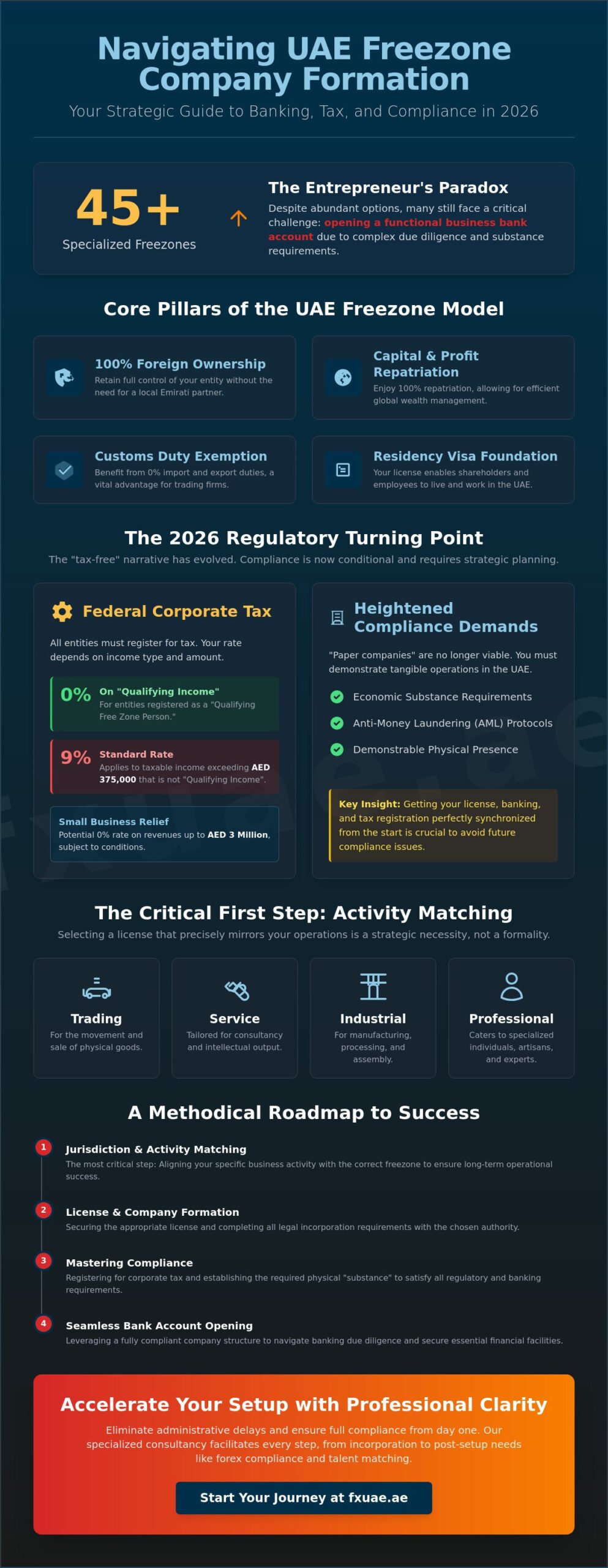
Did you know that there are now over 45 specialized jurisdictions for freezone company formation uae, yet many entrepreneurs still struggle to open a functional business bank account? It’s a common paradox. You’re promised 100% foreign ownership and significant tax benefits, but the reality often involves managing complex 2026 corporate tax rules and rigorous banking due diligence. You shouldn’t have to guess which zone fits your specific activity or worry if your income exceeds the AED 375,000 threshold for the 9% tax rate. We understand that these administrative hurdles can feel like a barrier to your professional momentum.
This strategic guide provides the professional clarity you need to move forward with confidence. We’ll show you how to satisfy regulatory compliance while securing the banking facilities your business requires to thrive. Our overview covers everything from qualifying for small business relief on revenues up to AED 3 million to choosing a license that guarantees long-term stability. By following this methodical approach, you can accelerate your setup process and ensure your entity remains fully compliant with the latest UAE financial regulations.
Key Takeaways
- Identify why matching your specific business activity to the correct jurisdiction is the most critical step for long-term operational success.
- Navigate the 2026 corporate tax landscape by understanding the criteria for the 0% qualifying income rate versus the standard 9% tax.
- Master the physical “substance” requirements that UAE financial institutions now demand to ensure a seamless business bank account opening.
- Streamline your freezone company formation uae by following a methodical, step-by-step roadmap designed to eliminate administrative delays.
- Discover how specialized financial consultancy facilitates essential post-incorporation needs like forex compliance and professional talent matching.
Understanding UAE Freezone Company Formation in 2026
A UAE Freezone is a geographically defined area that operates under its own unique regulatory framework, distinct from the mainland’s Department of Economy and Tourism (DET). Historically, these zones functioned as simple logistics and trade hubs. Today, they’ve matured into sophisticated regulatory ecosystems designed to foster specific industries. Whether you’re considering a specialized financial free zone or a prominent media free zone, the fundamental appeal remains the same: 100% foreign ownership. You don’t need a local Emirati partner to hold shares in your entity. This independence is a cornerstone of freezone company formation uae, offering international investors total control over their strategic direction.
The landscape is incredibly diverse. There are currently over 45 UAE Free Trade Zones, each catering to different niches such as media, technology, healthcare, or heavy industry. Choosing the right one requires more than a price comparison; it requires an understanding of which regulatory body best aligns with your operational goals. These zones offer a specialized environment where rules are tailored to the specific needs of the sector they serve.
The Core Pillars of the Freezone Model
The enduring popularity of this model rests on several structural advantages that simplify international business. First, investors enjoy the full repatriation of capital and profits, allowing for efficient global wealth management. Second, goods entering the zone are typically exempt from import and export duties; this is a vital cost-saver for trading and manufacturing firms. Finally, a freezone license serves as the foundation for UAE residency visas. This enables shareholders and their employees to live and work in the country, providing a stable base for long-term growth.
Why 2026 is a Turning Point for UAE Business
The regulatory environment in 2026 looks significantly different than it did even three years ago. The implementation of a federal corporate tax has shifted the “tax-free” narrative. While a 0% rate is still achievable, it’s now conditional. To maintain this incentive, your entity must earn “Qualifying Income” as a “Qualifying Free Zone Person.” If your taxable income exceeds AED 375,000 and doesn’t meet these specific criteria, a 9% tax rate applies. All entities must now register for tax, regardless of their location.
Additionally, there’s a heightened focus on transparency. International standards for Economic Substance and Anti-Money Laundering (AML) mean that companies can’t just exist on paper. You must demonstrate a physical presence and actual activity within the UAE. This evolution makes the initial stages of freezone company formation uae more technical, requiring a methodical approach to ensure your license, banking, and tax registration are perfectly synchronized. Precision at the start prevents expensive compliance hurdles later.
Selecting the Right Jurisdiction and License Type
Success starts with the license. It’s the blueprint for your entire operation. In the UAE, you’ll generally choose from four primary categories: Trading, Service, Industrial, or Professional. While a Trading license facilitates the movement of physical goods, a Service license is tailored for consultancy and intellectual output. Industrial licenses are reserved for manufacturing and processing, whereas Professional licenses cater to specialized individuals or artisans. According to the UAE Ministry of Economy guidelines, aligning your legal form with your intended activity is the first step toward institutional stability.
Activity matching isn’t just a formality; it’s a strategic necessity. If your license doesn’t precisely mirror your daily operations, you’ll face significant hurdles with customs, VAT registration, and corporate banking. Many entrepreneurs select a zone based on the lowest entry price, only to realize later that the jurisdiction doesn’t support their specific industry niche. For instance, a tech startup benefits from the ecosystem of Dubai Internet City, while a financial firm requires the robust framework of the DIFC. Getting this right during freezone company formation uae ensures you don’t have to restructure your business just as it gains momentum.
Specialized Licensing for Financial and Forex Firms
Financial activities require a higher tier of regulatory oversight. Navigating bodies like the Dubai Financial Services Authority (DFSA) or the Abu Dhabi Global Market (ADGM) requires deep expertise in compliance and capital requirements. These jurisdictions provide “sandboxes” for fintech innovators to test products in a controlled environment. However, for forex brokers, the path is more complex. You’ll need specialized consultancy to manage the rigorous licensing process and satisfy the strict “Fit and Proper” criteria. Understanding the full cost of forex license uae — from regulatory fees and mandatory share capital to operational expenditure across DIFC, DMCC, and SCA jurisdictions — is essential before committing to a structure. If you’re exploring these high-stakes sectors, our team can provide the Forex compliance assistance needed to secure your operational future.
Operational Flexibility: Flexi-desks vs. Physical Offices
Your choice of workspace directly impacts your visa quota and banking prospects. While a “Flexi-desk” or virtual office is a cost-effective entry point, it typically limits you to one or two residency visas. If your growth plan involves a larger team, you’ll need a physical office. Modern freezones are increasingly offering sustainability-focused spaces that cater to environmentally conscious brands. More importantly, UAE banks now prioritize “Economic Substance.” A physical office with a dedicated lease agreement significantly increases your chances of a successful business bank account opening. It proves to the bank that your company has a genuine, verifiable presence in the country.
Financial and Operational Advantages: Banking and Tax
The choice of jurisdiction directly influences your financial accessibility. Banks in the UAE maintain a specific “appetite” list for different economic zones. If you select a zone perceived as high-risk or one that lacks a robust regulatory reputation, your corporate account application might stall indefinitely. This is why freezone company formation uae must be viewed through a financial lens from day one. A common error is assuming that a freezone entity is an “offshore” vehicle. It’s actually a tax-resident onshore entity. This distinction is vital because it allows your business to access the UAE’s extensive network of double tax treaties while maintaining a legitimate local presence.
Current regulations in 2026 emphasize the concept of “Adequate Substance.” To benefit from the 0% corporate tax rate on qualifying income, your company must demonstrate that its core income-generating activities happen within the UAE. This requires having enough qualified employees and incurring a proportionate amount of operating expenditure locally. Without meeting these benchmarks, your business income over AED 375,000 will be subject to the standard 9% corporate tax rate. Precision in how you structure your operations is no longer optional; it’s a prerequisite for fiscal efficiency.
Streamlining Business Bank Account Opening
Securing a corporate account is often the most significant hurdle for new entrepreneurs. UAE financial institutions have intensified their due diligence processes, requiring comprehensive documentation to prove both “Source of Wealth” and “Source of Funds.” You must be prepared to show personal and corporate bank statements, proof of previous business experience, and a clear business plan. Delays often occur when there’s a mismatch between the license activity and the expected transaction profile. We provide specialized Business Bank Account Opening assistance to bridge this gap, ensuring your documentation meets the specific compliance standards of local and international banks.
VAT and Corporate Tax Compliance
Tax obligations don’t end with corporate tax registration. You must also monitor your turnover for Value Added Tax (VAT) compliance. The mandatory registration threshold is AED 375,000, while voluntary registration is possible at AED 187,500. Even if you qualify for the 0% corporate tax rate as a “Qualifying Free Zone Person,” you’re still required to maintain professional bookkeeping and undergo annual audits. Also, businesses with revenue not exceeding AED 3 million may elect for Small Business Relief until December 31, 2026. This relief can treat the business as having no taxable income for the period, providing a significant advantage for startups during their initial growth phase. Consistent, accurate financial reporting is the only way to safeguard these incentives.
The Step-by-Step Roadmap to Company Formation
Establishing a business presence in the UAE is a logical progression once you’ve identified your target market. While the process has become increasingly digitized, freezone company formation uae still requires a disciplined adherence to a specific sequence of approvals. Skipping a step or submitting incomplete data can lead to significant delays in your operational timeline. A methodical approach ensures that your entity is not only licensed but fully prepared for the 2026 regulatory environment.
- Step 1: Define Business Activities: You must select activities from the official list provided by the Free Zone Authority. This choice dictates your license type and impacts your eligibility for certain banking services.
- Step 2: Trade Name Reservation: Choose a name that complies with UAE naming conventions. It shouldn’t be similar to existing brands or include restricted religious or political references.
- Step 3: Initial Approval and Documentation: Submit your passport copies and a preliminary business plan to receive the “Initial Approval.” This indicates the authority has no objection to your business setup.
- Step 4: Legal Drafting and Leasing: You’ll sign the Memorandum of Association (MOA) and secure your office space. As established in previous sections, your lease agreement is a critical component for proving economic substance.
- Step 5: License Issuance and Visas: Once the final fees are paid, the authority issues your business license. You can then initiate the e-Channel registration to apply for residency visas for yourself, your family, and your staff.
If you’re ready to begin this process with a partner who understands the nuances of the local market, our specialists can facilitate your Freezone Company Setup with precision and speed.
Essential Documentation for Foreign Investors
The documentation phase is where many investors encounter hurdles. If your shareholder is a foreign corporate entity, you’ll need to provide attested documents from the UAE Embassy in the country of origin and the Ministry of Foreign Affairs in the UAE. Drafting a robust business plan is also essential; it’s not just a requirement for the freezone, but a primary document for bank compliance teams. Additionally, you must appoint a Manager and a Secretary during the formation. While one person can often hold multiple roles, their details must be clearly registered in the company’s official records.
Post-Licensing Requirements and Compliance
Receiving your license is a milestone, but it’s not the final step. In 2026, all new entities must register for Corporate Tax immediately to avoid penalties. You must also evaluate your VAT obligations if you expect your taxable supplies to exceed the AED 375,000 threshold. Managing your ongoing residency requirements happens through the e-Channel system, which streamlines visa renewals and immigration services. Finally, remember that your license requires annual renewal. Late renewals can result in daily fines of approximately AED 200 in certain jurisdictions like Dubai, so maintaining a compliance calendar is vital for long-term stability.
Why FXUAE is Your Strategic Partner in the UAE
Choosing a partner for freezone company formation uae involves more than comparing service fees. It’s about selecting a guide who understands the internal mechanics of the UAE’s financial regulators and banking institutions. At FXUAE, we don’t view ourselves as mere registration agents. We act as strategic consultants who bridge the gap between your entrepreneurial vision and the complex administrative hurdles of a high-stakes market. Our insider knowledge allows us to anticipate regulatory shifts, ensuring that your entity isn’t just established, but optimized for the 2026 fiscal landscape. We focus on removing anxiety through clarity, providing a steady hand as you navigate the intricacies of specialized jurisdictions.
Specialized Expertise for Financial Firms
How does your business plan to manage client funds or secure a compliance officer that satisfies the DFSA? These are the questions we solve daily. Our capability extends into niche areas that generalists often overlook, such as Forex compliance assistance and specialized talent matching. We facilitate the search for the right authorized individuals and compliance officers required to maintain your license in good standing. Beyond the initial setup, we streamline the opening of Client Money Accounts and specialized forex bank accounts. This provides the technical infrastructure needed for financial firms to operate with full transparency and regulatory alignment, ensuring your freezone company formation uae serves as a robust foundation for growth.
Tailored Support from Formation to Scale
Your professional journey doesn’t end when the license is issued. Scaling a business in the UAE requires constant vigilance over renewal deadlines, VAT filings, and evolving substance requirements. We provide the ongoing administrative support needed to navigate these responsibilities without distracting you from your core operations. Our team ensures that your corporate governance remains impeccable, protecting your institutional stability. By connecting you to our national network of professional partners and resellers, we ensure you have the resources to expand rapidly and efficiently. If you’re ready to secure your place in the region’s most dynamic economic zones with a partner who values precision, you should schedule a consultation with our setup experts today to begin your journey with confidence.
Securing Your Operational Future in the UAE
The landscape of freezone company formation uae has evolved into a sophisticated regulatory environment that rewards precision. Success in 2026 depends on more than just obtaining a license. It requires a strategic alignment of your business activity with the right jurisdiction and a proactive approach to economic substance. By securing your physical presence and understanding your tax obligations early, you protect your entity from future compliance risks. You don’t have to manage these complexities alone. As a specialized division of BizDesign Corporate Services, FXUAE brings a wealth of institutional stability to your setup process.
Our expertise in niche financial and forex licensing ensures that even the most complex structures are established with a focus on long-term viability. We provide integrated banking and compliance facilitation, removing the traditional barriers to entry for international investors. Whether you’re navigating new corporate tax thresholds or seeking specialized talent, we act as your dedicated strategic partner. It’s time to transform your entrepreneurial ambition into a compliant, scalable reality. Start your UAE Freezone journey with FXUAE’s expert guidance and build your business on a foundation of professional certainty.
Frequently Asked Questions
Can a foreigner own 100% of a company in a UAE Freezone?
Yes, 100% foreign ownership is a foundational benefit for those undergoing freezone company formation uae. Unlike certain mainland structures that previously required a local sponsor, freezone jurisdictions allow international investors to retain total control of their shares. This independence ensures a secure environment for capital and profit repatriation without the necessity of a local partner.
How long does it take to complete freezone company formation in the UAE?
The registration process typically ranges from three to ten working days, depending on the specific jurisdiction and the nature of your business activities. Digitalized platforms in zones like Meydan or IFZA have streamlined approvals significantly. However, if your activity requires external regulatory clearance from bodies like the KHDA or the Dubai Health Authority, the timeline will naturally extend to accommodate these additional reviews.
Do I need to live in the UAE to run a freezone company?
You aren’t required to reside in the UAE to own or manage a freezone entity. Many entrepreneurs successfully operate their businesses from abroad. It’s important to note, however, that most local financial institutions require the company’s manager or a shareholder to hold a UAE residency visa to open a corporate bank account. Maintaining a local presence also helps satisfy “Economic Substance” requirements for certain tax-resident benefits.
What is the difference between a freezone company and an offshore company?
A freezone company is an onshore, tax-resident entity that allows for physical office space and residency visas. Conversely, an offshore company is a non-resident vehicle used primarily for international asset holding or logistics. Offshore entities cannot rent local office space or issue visas. Freezone companies are generally preferred for active trading or services because they provide better access to UAE banking and double tax treaties.
Is it difficult to open a business bank account for a freezone entity?
Opening a business bank account is often the most rigorous part of the setup process due to global anti-money laundering standards. Banks conduct thorough due diligence on your “Source of Wealth” and the legitimacy of your business model. While it’s more complex than the initial licensing, having a physical office and a professionally drafted business plan will significantly improve your chances of a successful application.
What are the annual costs associated with maintaining a freezone license?
Annual maintenance involves license renewal fees, which typically range from 70% to 100% of your initial registration cost. You must also account for office lease renewals, mandatory health insurance for employees, and professional fees for bookkeeping or annual audits. Keeping these renewals current is vital; late filings can result in daily penalties of around AED 200 in jurisdictions like Dubai.
Do freezone companies pay corporate tax in the UAE in 2026?
Yes, all freezone entities must register for corporate tax and file annual returns. While a 0% rate is available for “Qualifying Income” earned by eligible persons, a standard 9% tax rate applies to taxable income exceeding AED 375,000. It’s essential to maintain accurate financial records to prove your eligibility for any tax incentives or small business relief programs available through 2026.
Can a freezone company trade directly with the UAE mainland?
Freezone companies can trade with the mainland, but they usually must do so through a licensed local distributor or by establishing a mainland branch. For service-based firms, work can often be performed for mainland clients as long as the primary activity takes place within the freezone. Navigating these boundaries correctly is a critical part of freezone company formation uae to ensure your operations remain fully compliant.